> For the complete documentation index, see [llms.txt](https://docs.p0.dev/llms.txt). Markdown versions of documentation pages are available by appending `.md` to page URLs; this page is available as [Markdown](https://docs.p0.dev/settings/settings.md).
# Settings
View scan status, edit your environment's schedule and monitors, and see who can access these settings.
The Settings page controls your selected environment. Seeing **Settings** in the navigation requires the [Owner or Assessment User](/p0-management/role-based-access-control.md) role, and at least one environment already set up. Once you're on the page, it's organized into three tabs: **Status**, **Configuration**, and **Monitors**. [Owners, Assessment Users, and Assessment Viewers](/p0-management/role-based-access-control.md) can view Status. Configuration and Monitors are limited to Owners and Assessment Users.
{% hint style="info" %}
**Don't see Settings?**
Settings appears once your organization has at least one environment. If none exists yet, see [Creating an environment](/getting-started/creating-an-environment.md). If an environment exists, you need the [Owner or Assessment User](/p0-management/role-based-access-control.md) role.
{% endhint %}
At the top of the page, a dropdown shows which environment you're looking at, with an icon for its scan status. Use it to switch between environments. Every tab on this page follows the selected environment. Next to the dropdown, a label shows when the environment last completed a scan, for example "Last run 3 hours ago". It reads "Running" while a scan is in progress, or "Hasn't been run yet" if it never has. Hovering explains that this reflects the last *completed* run. Next to that, the target integrations' logos open a popover listing the specific accounts, projects, or subscriptions this environment scans.
### Status
The **Status** tab shows the progress of the environment's most recent or running assessment: a checklist of stages, each marked not started, in progress, or completed, with an error message if the job failed.
An Owner or Assessment User can also click **Run unscheduled assessment now** to trigger a scan outside the regular schedule. The button is disabled while a scan is already in progress, and enables again once that scan finishes.
### Configuration
The **Configuration** tab has the following sections, in order:
{% hint style="info" %}
If your Google Cloud or AWS installation is incomplete, an alert appears at the top of the page linking to the [Google Cloud](/integrations/resource-integrations/google-cloud/iam-assessment.md) or [AWS](/integrations/resource-integrations/aws/iam-assessment.md) IAM assessment install guide. Existing assessments won't run correctly until you fix it.
{% endhint %}
#### Name
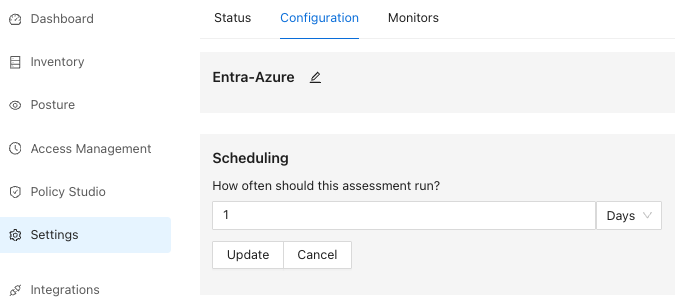
Rename the environment using the edit icon next to its title.
#### Scheduling
You can edit the frequency at which your assessment runs, or disable scheduled runs altogether in this section.
#### Assignment
Set how P0 assigns a finding's owner by default when you [triage it](/posture/finding-details.md): **Manually**, or by **Resource contact**. For GCP targets, this is the project's technical contact. For AWS targets, it's the account's operations contact.
#### Scope
A read-only list of the [targets](/getting-started/creating-an-environment/environment-terminology.md) this environment scans.
#### Danger Zone
**Delete Environment** permanently deletes this environment after you confirm in a dialog. This can't be undone. P0 then switches you to another environment if you have one, or back to the Dashboard if this was your only one.
### Monitors
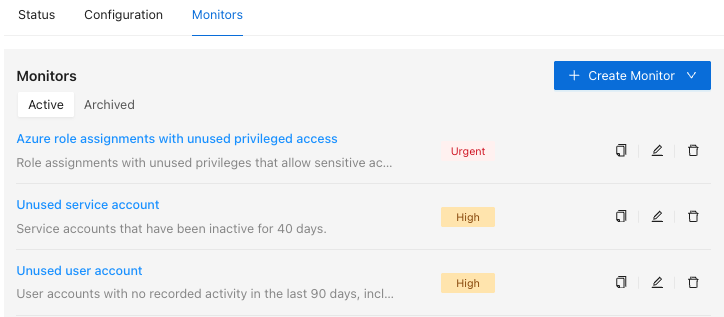
The **Monitors** tab lets you view, create, edit, and archive [monitors](/getting-started/creating-an-environment/environment-terminology.md). Toggle between **Active** and **Archived** monitors with the switch above the list.
An Owner or Assessment User can click **Create Monitor** to build one from scratch or from a template. Both open the monitor creation flow, described in [Create a custom monitor](/posture/create-a-custom-monitor.md).
Each monitor's row has Edit and Archive (or Unarchive) actions, plus a "Use as template" action on P0's built-in monitors:
* **Edit** a custom monitor to change its label, search query, description, severity, scope, or Jira auto-assignment. Editing one of P0's built-in monitors only lets you change its severity and Jira auto-assignment. Its label, search query, description, and scope are fixed.
* **Archive** a monitor to remove it from future assessment runs and from your default findings view. Archived monitors can be unarchived later, which adds them back to future runs.