> For the complete documentation index, see [llms.txt](https://docs.p0.dev/llms.txt). Markdown versions of documentation pages are available by appending `.md` to page URLs; this page is available as [Markdown](https://docs.p0.dev/integrations/resource-integrations/google-cloud/security-perimeter.md).
# Security perimeter
This page describes how to set up a Cloud Run security perimeter for P0 to manage access in your Google Cloud environment.
## What is P0's GCP security perimeter?
The P0 GCP security perimeter is a lightweight Cloud Run agent that allows P0 to manage access in your Google Cloud environment, while preventing malicious access to your environment. It is the IAM-layer P0 connector for Google Cloud. See [P0 connectors](/readme/connectors.md).
## Prerequisites
* [Google Cloud](/integrations/resource-integrations/google-cloud.md#set-up-your-organization).
* Identify a Google Cloud project where you want to install P0 GCP security perimeter. P0 recommends that you create a separate google cloud project to deploy this security perimeter.
* Obtain permissions to create a GCP cloud run service, create GCP roles, and add IAM bindings to the project. These permissions can be gained via the `editor` role.
{% hint style="info" %}
Contact P0 support for access to the GCP security perimeter code repo.
{% endhint %}
## Install the security perimeter
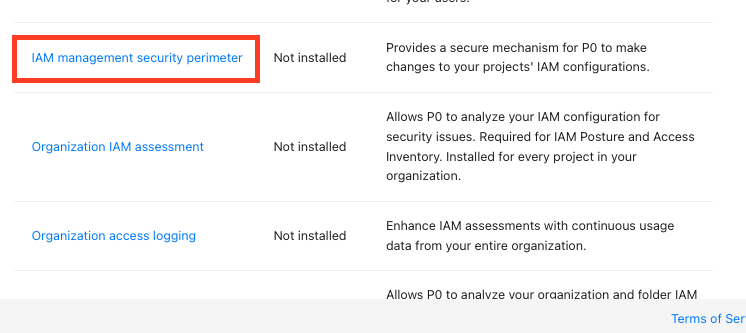
1. Choose the **IAM management security perimeter** component.
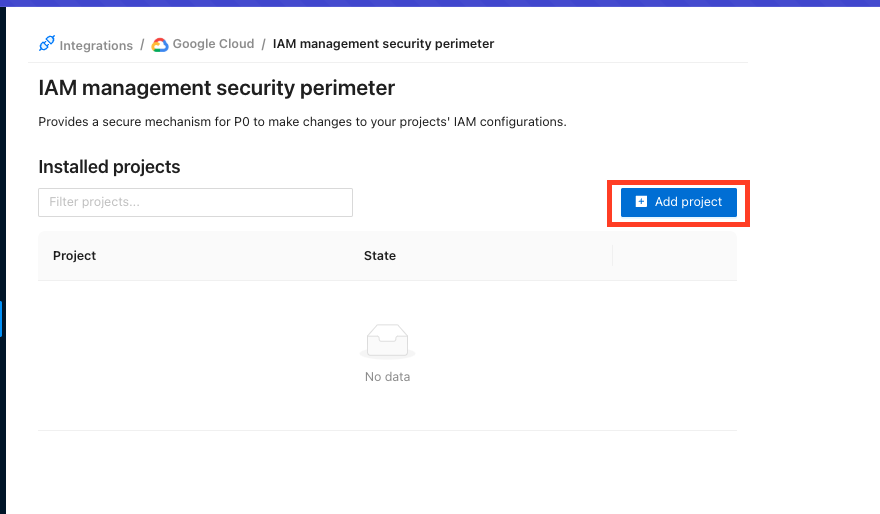
2. Click **Add project** to install a new project.
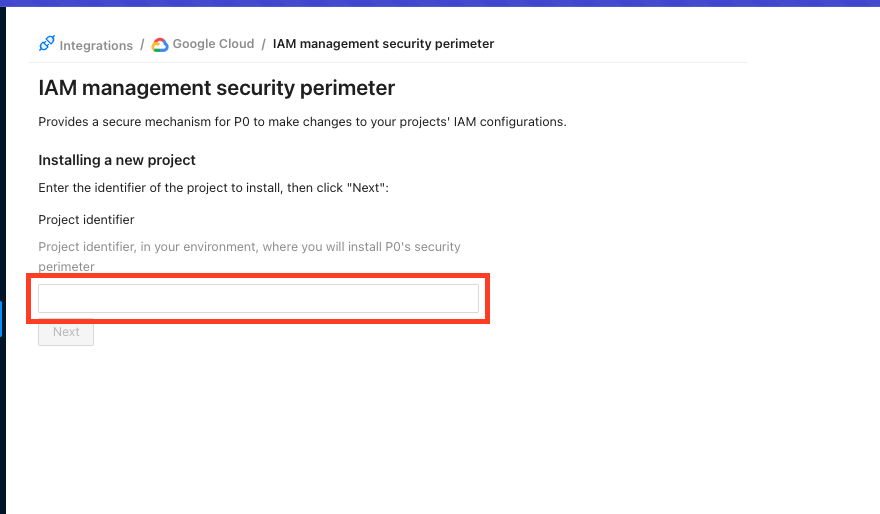
3. Enter the Google project name into the **Project identifier** field.
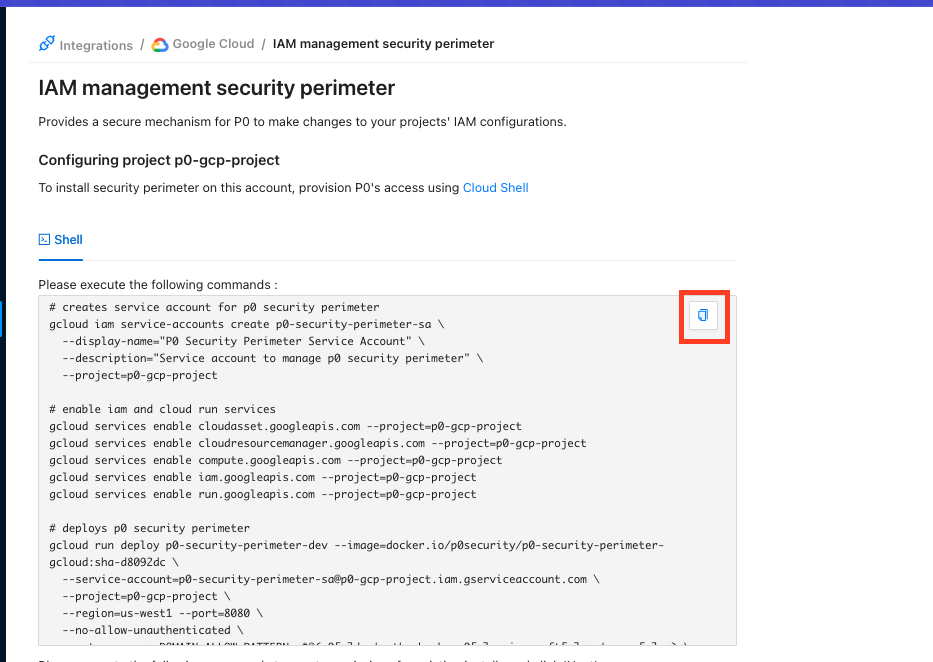
4. The resulting page will display GCP commands to complete the installation.\
Run these instructions in Cloud Shell:
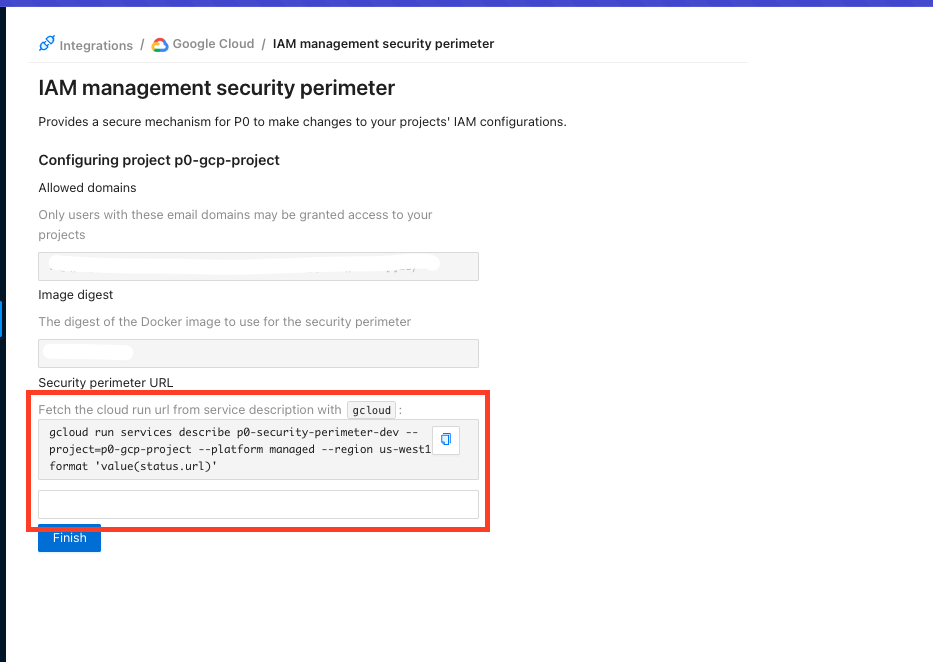
5. Retrieve the Cloud Run url by running the displayed command in Cloud Shell:
6. Click **Finish** to complete the installation.
{% hint style="success" %}
Congratulations! You can now install Google Cloud IAM management component.
{% endhint %}